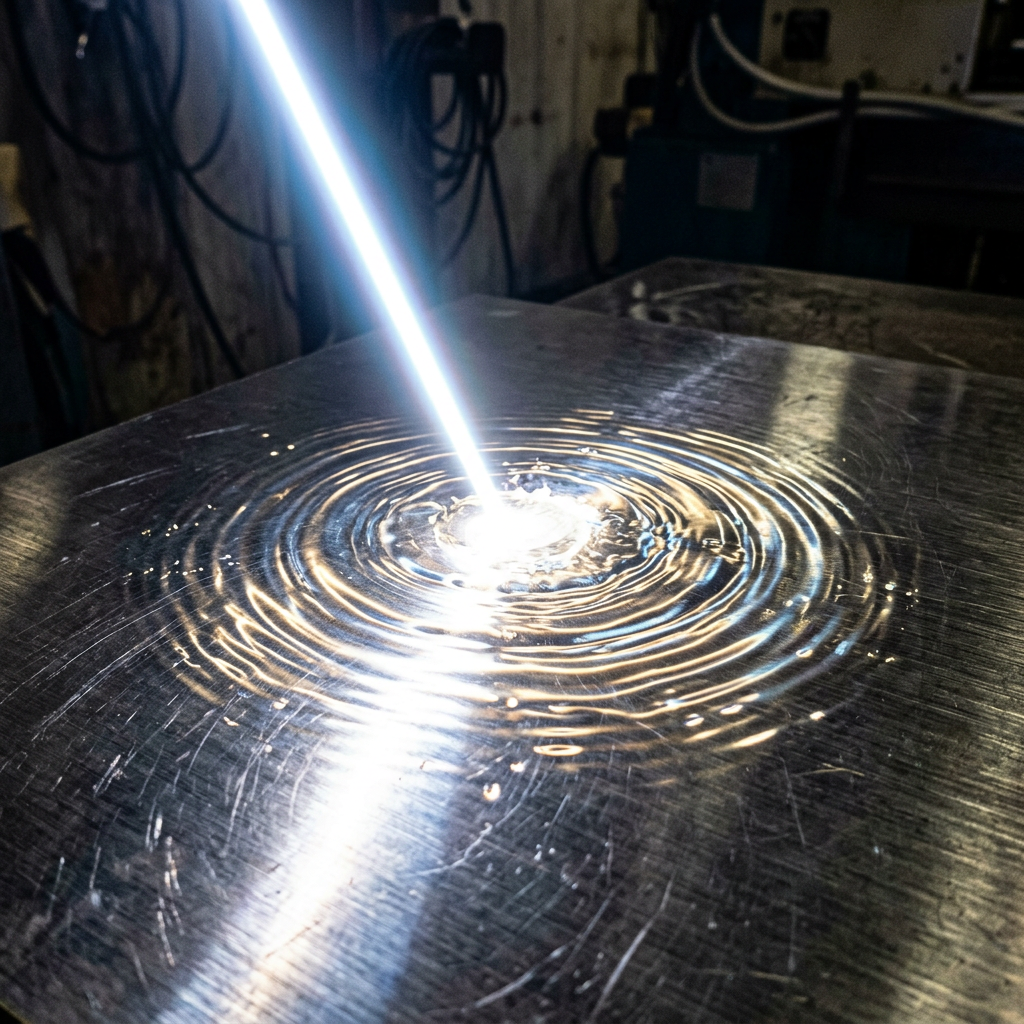
Physics has always been at its best when it relies on observable, physical mechanics rather than abstract mathematics. When you look at a pencil resting in a half-empty glass of water, the pencil appears broken and bent at the surface. We do not invent an invisible fourth dimension to explain this; we simply understand that water is a physical medium, and light moves slower through it.
It is my deepest conviction that the entire universe operates on this exact same principle of mechanical simplicity. We do not need convoluted quantum loopholes or abstract geometries to explain reality. Space is not an empty mathematical void—it is a physical, hyperelastic fluid.
Today, I am thrilled to announce a major evolution in this research with a newly completed standalone manuscript. We are applying the Fluid Vacuum Paradigm to permanently resolve one of the most stubborn paradoxes in modern physics: the Photoelectric Effect and the myth of wave-particle duality.
The Photon Illusion
For over a century, the standard model of physics has told us that light is both a wave and a discrete particle (the “photon”). This bizarre compromise was born entirely from the Photoelectric Effect.
In 1905, it was observed that shining light on a metal surface only ejects electrons if the light’s frequency is high enough. If you shine a low-frequency light—no matter how blindingly intense or bright it is—nothing happens. Standard physics concluded that continuous waves couldn’t explain this, so light must be made of discrete “bullets” of energy. If the bullet doesn’t have enough baseline energy (frequency), it can’t knock the electron loose.
This assumption birthed the wave-particle duality paradox. It conflated the nature of the incoming light with the structural limits of the target atom.
Continuous Wave Resonance: The Mechanical Reality
In our new manuscript, we eliminate the need for the photon entirely. By treating the vacuum of space as a physical, non-linear hyperelastic medium, we prove that light is always, exclusively, a continuous wave. The discrete, quantized behavior observed in the laboratory is actually a property of the atom itself.
Here is the mechanical reality:
- The Bound Geon: In the fluid vacuum, an electron is not a solid particle. It is a tightly knotted vortex of wave-energy (a Geon). When bound inside an atom, this vortex is tethered in a circular orbit around the nucleus. Think of it as a spinning smoke ring tied to a central post.
- Off-Resonance Dissipation: When continuous light washes over the metal, it acts as a rhythmic driving force. If the light’s frequency does not perfectly match the electron’s orbital rotation, the hyperelastic vacuum simply scatters the energy away as heat. You can turn up the intensity all you want, but the non-linear medium prevents the atom from absorbing off-resonance energy.
- Topological Emancipation: When the incoming light hits the exact threshold frequency, it phase-locks with the electron. This creates perfect constructive resonance. The atom violently absorbs the continuous wave-energy until the orbital tether reaches its absolute structural yield limit. The bond mechanically snaps, launching the fully intact electron vortex out of the metal.
The photoelectric effect is not proof that light travels in discrete particles. It is the mechanical emancipation of a trapped wave-vortex by a continuous spatial ripple. It is classical continuum mechanics at its finest.
The Path Forward: Unifying the Cosmos
While this newly released manuscript focuses entirely on the sub-atomic mechanics of the photoelectric effect, the Fluid Vacuum Paradigm is a universal framework. The exact same mechanical logic that applies to the atom applies to the stars.
In upcoming sections of this thesis, we will expand this continuum mechanics approach to absorb the macroscopic phenomena currently governed by Special and General Relativity.
Leave a Reply